
Imagine having a digital employee that doesn’t just answer questions but can plan a task, use software, access information, make decisions, and complete the work for you. That is the promise of AI agents.
The combination of AI agents + tools is rapidly changing how businesses and individuals automate repetitive work. Instead of relying solely on a chatbot, AI agents can connect to external tools such as search engines, databases, calendars, CRMs, spreadsheets, APIs, and business applications.
But how do AI agents actually work, and which tools make them useful? Let’s break it down.
What Are AI Agents?
An AI agent is a software system powered by artificial intelligence that can pursue a goal through multiple steps with limited human intervention.
Traditional AI typically responds to a single prompt. An AI agent can go further:
- Understand the objective.
- Break the objective into smaller tasks.
- Decide which actions are required.
- Use available tools.
- Evaluate the results.
- Continue or adjust its approach.
- Deliver the final outcome.
For example, instead of asking an AI to “write a sales report,” you could give an AI agent access to your sales database, spreadsheet, and reporting software. The agent could retrieve the latest numbers, calculate key metrics, identify trends, create a report, and prepare it for review.
This makes AI agent automation particularly valuable for complex workflows.
Why AI Agents Need Tools
An AI model by itself has limitations. It can generate text and reason about information, but it may not have direct access to your current business data or the ability to perform actions in external applications.
Tools provide those capabilities.
Common AI Agent Tools
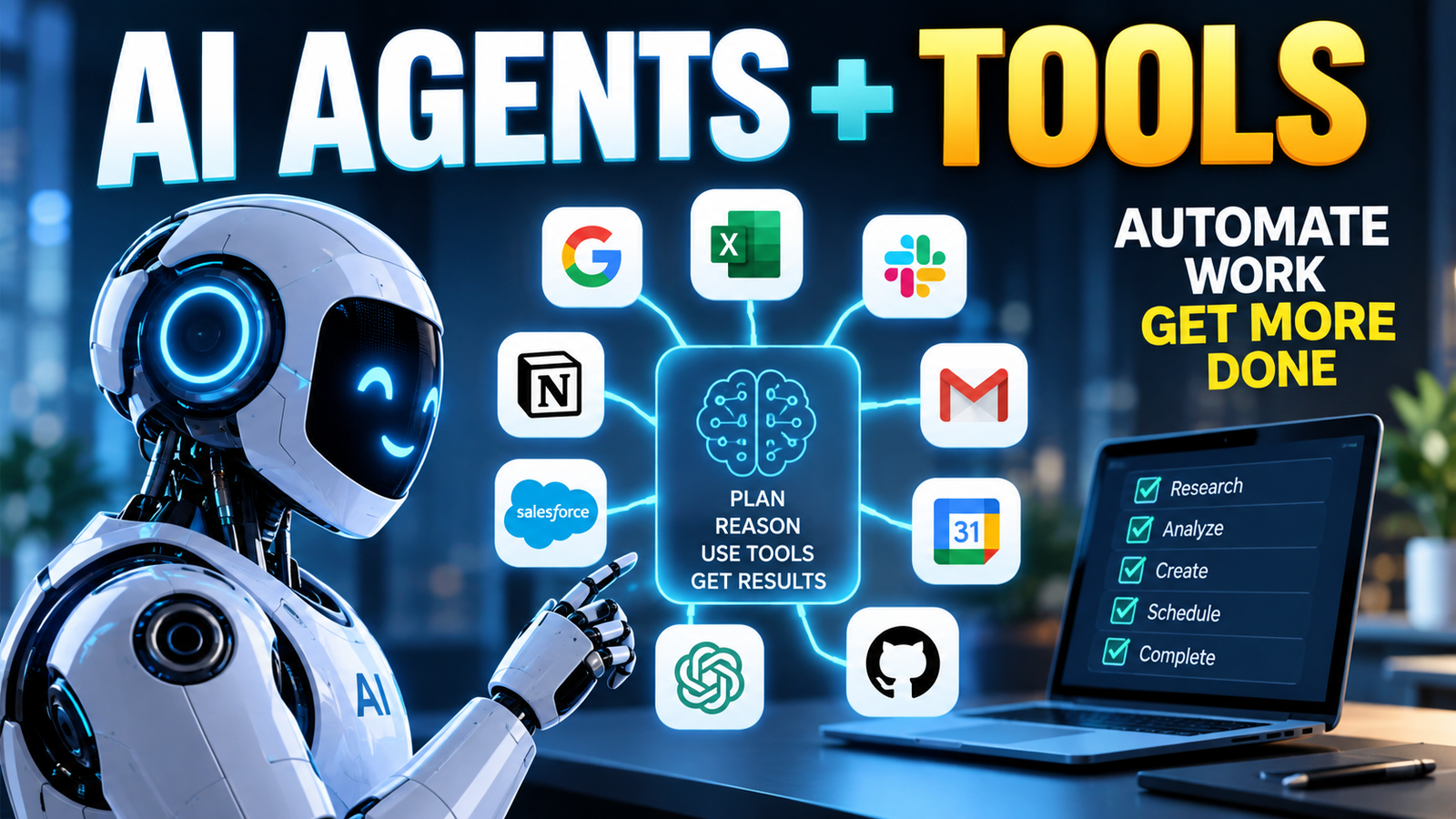
AI agents can connect with many types of tools, including:
- Web search tools: Find current information and research sources.
- APIs: Communicate with external software and services.
- Databases: Retrieve and analyze structured business information.
- CRM tools: Update customer records and manage sales activities.
- Email tools: Draft, organize, or send messages when authorized.
- Calendar tools: Schedule meetings and manage appointments.
- Spreadsheet tools: Analyze financial, sales, or operational data.
- Code execution tools: Perform calculations, transform data, and automate technical tasks.
The key idea is simple: the AI decides what needs to happen, while tools enable it to happen.
AI Agents vs. Traditional Automation
Traditional automation generally follows predefined rules: If X happens, do Y.
AI agents are more flexible. They can interpret unstructured information, select appropriate actions, and adapt when circumstances change.
For instance, a traditional workflow might automatically send the same follow-up email three days after every sales call. An AI agent could examine the customer’s previous interactions, understand the conversation, research relevant information, and prepare a personalized follow-up.
This flexibility makes AI agents attractive for business process automation, customer service, research, sales, and operations.
Real-World AI Agent Examples
1. Sales and Marketing
An AI sales agent could research prospects, enrich customer information, prioritize leads, draft personalized outreach, and update a CRM.
2. Customer Support
A support agent can identify a customer’s issue, search a knowledge base, check an order system, and recommend an appropriate solution.
3. Financial Operations
AI agents can help analyze transactions, reconcile information, generate financial summaries, and flag unusual patterns for human review.
4. Research and Data Analysis
A research agent can search multiple sources, collect relevant information, compare findings, analyze data, and produce a structured report.
How to Build an Effective AI Agent Workflow
The best AI agent isn’t necessarily the one with the most tools. It is the one with the right tools and clearly defined permissions.
Start With One Repetitive Workflow
Identify a task that consumes significant time but follows a reasonably predictable process. Examples include reporting, lead qualification, document processing, or research.
Give the Agent Reliable Tools
Choose tools that provide accurate, structured information. Poor data sources can produce poor decisions regardless of how capable the AI model is.
Add Human Approval Where It Matters
For sensitive actions—such as financial transactions, legal decisions, or important customer communications—consider requiring human approval before the agent takes the final action.
Measure Business Results
Track metrics such as time saved, operating costs, accuracy, conversion rates, and task completion rates. AI automation should solve a measurable business problem rather than simply exist as a technology experiment.
The Future of AI Agents + Tools
AI agents are moving from simple chat interfaces toward action-oriented AI systems capable of completing multi-step workflows. As integrations, models, and security controls improve, organizations will increasingly use agents as a layer connecting employees, data, and software.
The biggest opportunity isn’t replacing every human task. It’s removing repetitive work so people can spend more time on strategy, creativity, relationships, and decisions that genuinely require human judgment.
Conclusion
AI agents + tools represent a major evolution in automation. AI provides reasoning and decision-making capabilities, while tools give agents access to real-world information and actions.
Whether you’re building an AI-powered business workflow, improving customer service, automating research, or simply looking for ways to save time, the winning approach is to start small, use reliable tools, maintain appropriate human oversight, and measure the results.
The future of AI isn’t just about machines that can talk. It’s about intelligent systems that can understand, act, and get work done.