
Imagine a robot that doesn’t just follow a fixed command but can see a warehouse, understand its surroundings, make decisions, and safely move objects around people. That is the promise of Physical AI.
Unlike traditional AI, which mainly works with digital information such as text, images, and data, Physical AI brings intelligence into the physical world. It enables robots, autonomous vehicles, drones, industrial machines, and other smart devices to perceive their environments, reason about what they observe, and take action.
As businesses invest heavily in AI automation, robotics, autonomous systems, and smart manufacturing, Physical AI is quickly becoming one of the most important technologies shaping the future.
What Is Physical AI?
Physical AI refers to artificial intelligence systems designed to interact with and operate in the physical world. These systems combine AI models with sensors, cameras, robotics hardware, control systems, and real-time computing.
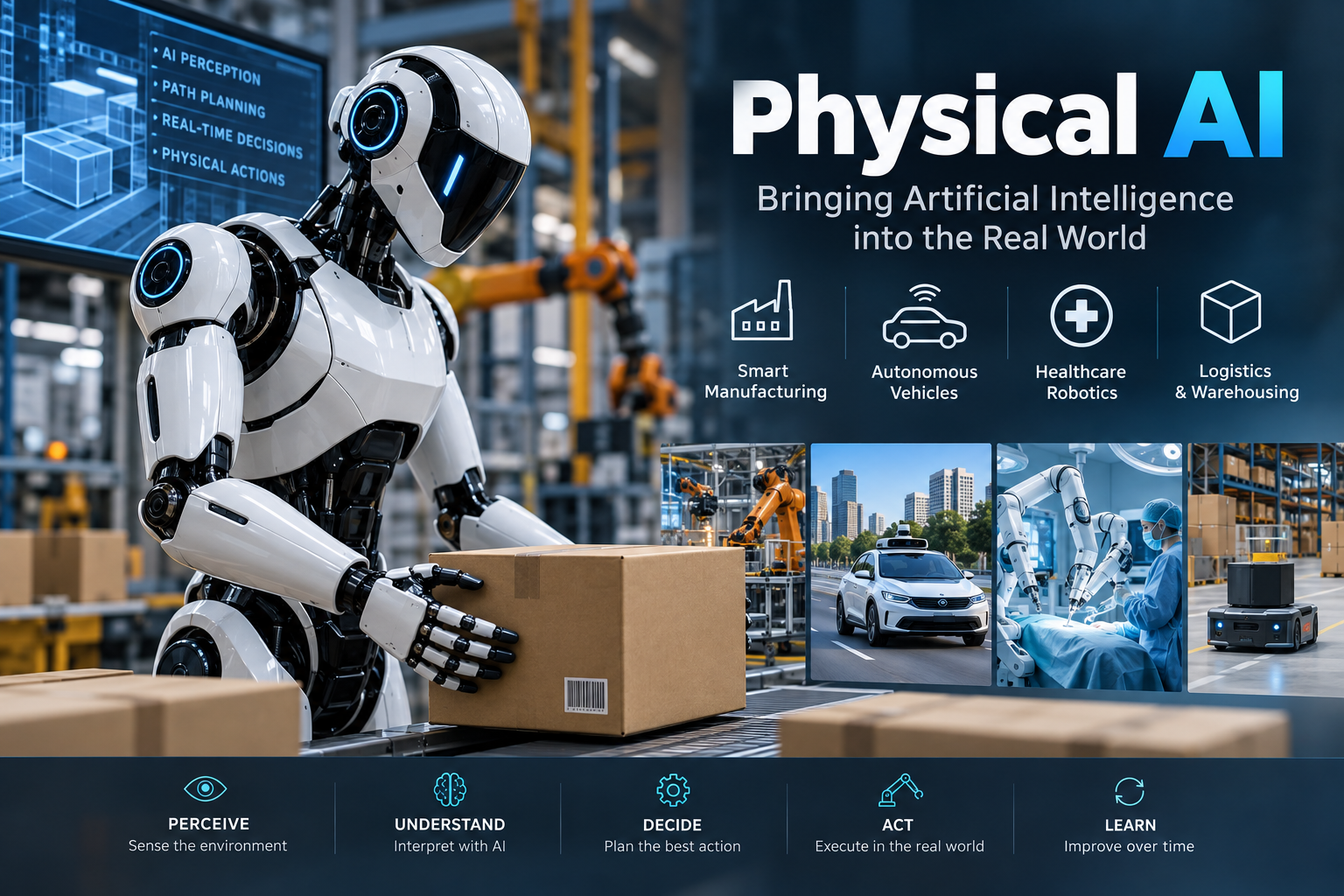
A Physical AI system typically follows a continuous cycle:
- Perceive: Sensors and cameras collect information about the environment.
- Understand: AI interprets objects, movement, obstacles, and conditions.
- Decide: The system determines the best action.
- Act: Motors, robotic arms, wheels, or other mechanisms execute the decision.
- Learn: Feedback helps improve future performance.
For example, an autonomous vehicle uses cameras, radar, GPS, and other sensors to understand road conditions. AI then helps it decide when to accelerate, brake, turn, or avoid an obstacle.
How Does Physical AI Work?
Sensors and Perception
Physical AI starts with perception. Cameras, lidar, radar, microphones, pressure sensors, and other technologies allow machines to collect information from their surroundings.
Computer vision can help a robot identify objects, while depth sensors can estimate distances. This sensory information gives AI a digital representation of the physical environment.
AI Models and Decision-Making
The next step is reasoning. Machine learning and increasingly sophisticated AI models analyze sensor data and determine what should happen next.
For instance, a warehouse robot may recognize a package, calculate a safe route, and decide how to pick it up without damaging the contents.
Robotics and Control Systems
Intelligence alone is not enough. Physical AI needs reliable hardware and control systems to turn decisions into physical movements.
Robotic arms, autonomous mobile robots, drones, and humanoid robots can execute actions based on AI-generated decisions. Precise control is particularly important in environments where a small error could damage equipment or injure a person.
Real-World Applications of Physical AI
Manufacturing and Industrial Automation
Factories are among the biggest beneficiaries of Physical AI. Intelligent robots can perform assembly, inspection, material handling, and quality-control tasks.
AI-powered automation can potentially improve productivity while reducing repetitive manual work and helping manufacturers operate more consistently.
Autonomous Vehicles
Self-driving cars and autonomous delivery systems are major examples of Physical AI. They must understand constantly changing environments and make decisions in real time.
The technology also extends to autonomous trucks, agricultural machinery, warehouse vehicles, and other transportation systems.
Healthcare and Medical Robotics
Physical AI is increasingly relevant to healthcare robotics. Intelligent systems can assist with rehabilitation, logistics, patient support, and certain surgical applications.
The goal is not simply to replace human expertise but to provide greater precision, consistency, and assistance where appropriate.
Smart Warehouses and Logistics
E-commerce has increased demand for faster and more efficient logistics. AI-powered robots can move inventory, sort packages, navigate facilities, and work alongside human employees.
This creates opportunities for businesses to reduce operational bottlenecks and improve warehouse efficiency.
Benefits and Challenges
The biggest advantage of Physical AI is its ability to connect intelligence with action. Instead of merely recommending what a person should do, an intelligent machine can perform the task.
Potential benefits include:
- Greater operational efficiency
- Reduced repetitive labor
- Improved precision and consistency
- Faster decision-making
- Safer handling of certain hazardous tasks
- More flexible industrial automation
However, Physical AI also presents challenges. Hardware can be expensive, AI systems can make mistakes, and real-world environments are unpredictable. Businesses must consider robot safety, cybersecurity, privacy, reliability, regulatory compliance, and ongoing maintenance.
How Businesses Can Prepare for Physical AI
Companies considering Physical AI should start with a practical problem rather than adopting technology simply because it is fashionable.
Identify repetitive or high-cost processes where automation could produce measurable value. Then evaluate the required sensors, robotics hardware, AI software, infrastructure, and employee training.
A pilot project is often a sensible starting point. Businesses can measure productivity, error rates, operating costs, safety outcomes, and return on investment before expanding the system.
The Future of Physical AI
Physical AI could fundamentally change how humans interact with machines. As AI models become more capable and robotics hardware becomes more affordable, intelligent machines are likely to appear in more workplaces and everyday environments.
The future may include robots that can learn new tasks from demonstrations, autonomous machines that collaborate naturally with people, and intelligent systems capable of adapting to unfamiliar situations.
The key shift is simple: AI is moving beyond screens and into the physical world.
Conclusion
Physical AI represents the convergence of artificial intelligence, robotics, sensors, and real-world decision-making. From factories and warehouses to transportation and healthcare, it is creating new possibilities for automation and intelligent machines.
For businesses, the opportunity is significant—but success will depend on more than buying advanced robots. Organizations need clear use cases, reliable infrastructure, strong safety practices, and a strategy for integrating AI with human expertise.
As digital intelligence gains a physical presence, Physical AI may become one of the defining technologies of the next era of automation.